
Ultrasonic Welding vs RF Welding: Which Process Fits Your Part?
24 June 2026 · 7 min read · Techspan engineering
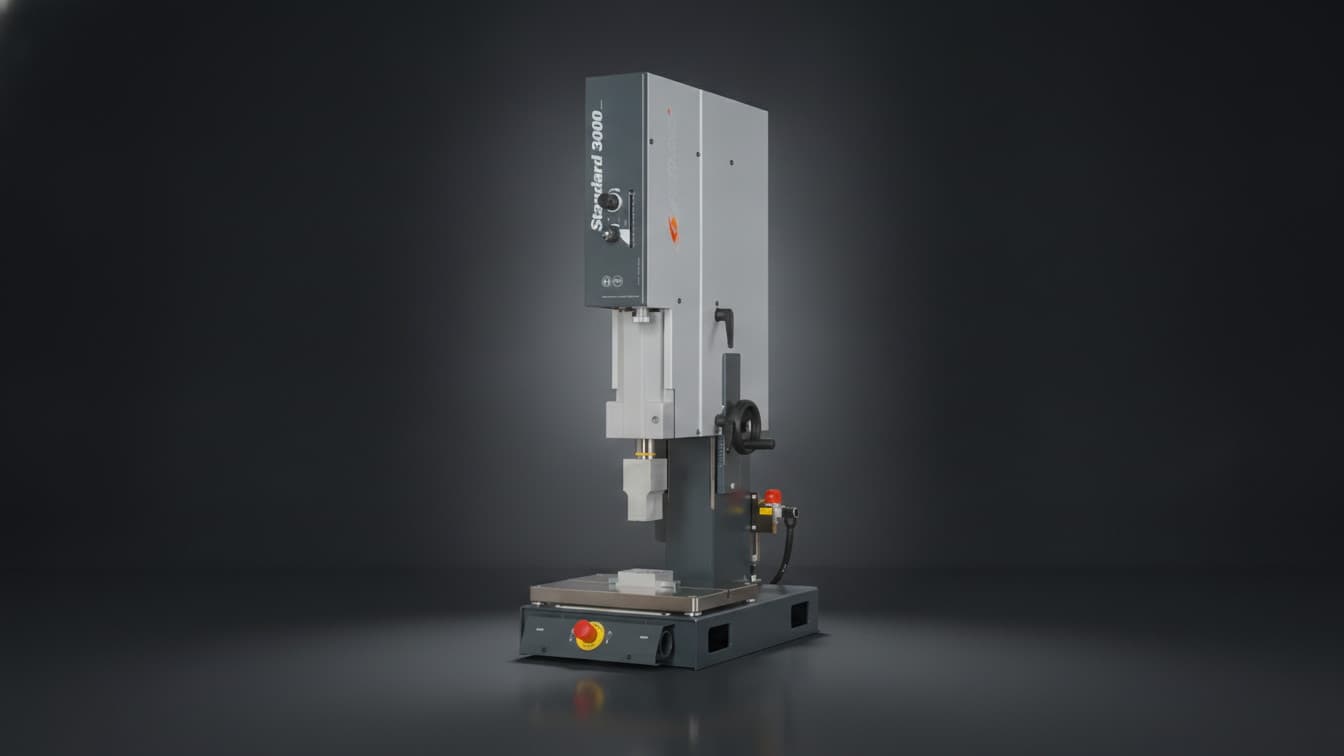
Ultrasonic welding and radio frequency (RF) welding are the two most common ways to join plastics without adhesives, solvents or fasteners. Both create a genuine molecular bond. Both run fast enough for production. Beyond that, they are fundamentally different processes, and picking the wrong one for your material is an expensive mistake. This guide explains how each works, where each excels, and how to decide between them.
How ultrasonic welding works
Ultrasonic welding converts electrical energy into high-frequency mechanical vibration — typically 20 kHz or 35 kHz. An ultrasonic generator drives a convertor, which turns the electrical signal into vibration. A booster adjusts the amplitude, and a horn (sonotrode) presses the vibration into the part under controlled force.
The vibration creates intermolecular friction concentrated at the joint line, usually at a small triangular feature called an energy director. The plastic at that point melts in a fraction of a second, the vibration stops, and the melt solidifies under pressure. Typical weld times are 0.1 to 1 second, with total cycle times of a few seconds including handling.
Because the heat is generated mechanically inside the material, ultrasonic welding works on almost any rigid thermoplastic — ABS, polycarbonate, acrylic, polystyrene, nylon, polypropylene and many more. Machines range from benchtop units like the Easy 3000 to servo-driven production systems such as the Electrical Motion series.
How RF welding works
RF welding (also called high-frequency or dielectric welding) uses an electromagnetic field, typically at 27.12 MHz, applied between two electrodes. The field rapidly reverses polarity millions of times per second. If the material between the electrodes has polar molecules — molecules with an uneven charge distribution — those molecules oscillate with the field and generate heat throughout the material thickness.
This is the critical difference: RF welding only works on polar materials. PVC (polyvinyl chloride) and PU (polyurethane) are the classic examples. Non-polar plastics such as polyethylene and polypropylene are essentially transparent to the RF field and will not heat.
RF welding excels at joining thin, flexible films and coated fabrics over large areas — think inflatable products, medical fluid bags, tarpaulins, blood pressure cuffs and welded seams on PVC-coated textiles. Weld times are longer than ultrasonic, typically 2 to 10 seconds, because the whole electrode area heats and cools as one.
Side-by-side comparison
| Factor | Ultrasonic welding | RF welding |
|---|---|---|
| Operating principle | Mechanical vibration, 20–70 kHz | Electromagnetic field, 27.12 MHz |
| Best materials | Rigid thermoplastics (ABS, PC, PMMA, PS, PP, PA) | Polar films and fabrics (PVC, PU, some EVA) |
| Poor materials | Flexible PVC, PU film, high-filler compounds | PE, PP, PS and other non-polar plastics |
| Typical weld time | 0.1–1 s | 2–10 s |
| Part format | Moulded parts, small weld areas, spot and seam welds | Films, sheets, coated fabrics, large seam areas |
| Joint design | Needs designed joint (energy director or shear joint) | Electrode shape defines the weld; simple lap seams |
| Energy use | Low — energy only during the brief weld pulse | Moderate — field applied for the full dwell |
| Tooling cost | Machined titanium or aluminium horn per part | Machined brass or aluminium electrode per seam |
| Safety considerations | Audible noise at 20 kHz; guarding and enclosures | RF field shielding and interlocks required |
Material compatibility is the first gate
Before comparing anything else, check the material. The two processes barely overlap:
- Choose ultrasonic for rigid thermoplastic mouldings. Amorphous plastics such as ABS, polycarbonate and acrylic weld easily. Semi-crystalline plastics such as polypropylene, polyethylene and nylon weld well with correct joint design and higher amplitude — typically at 20 kHz.
- Choose RF for flexible PVC and polyurethane films or coated fabrics. These materials absorb ultrasonic vibration instead of concentrating it at the joint, so they weld poorly ultrasonically — but their polar chemistry makes them ideal for RF.
- Non-polar films (PE, PP) cannot be RF welded at all. For these, ultrasonic seam welding, hot-air or impulse welding are the options.
Joint design and part geometry
Ultrasonic welding needs the joint designed in from the start. A moulded energy director — a small triangular bead, typically 0.3 to 0.8 mm high — concentrates the vibration and defines where melting begins. Shear joints suit semi-crystalline materials and parts needing a hermetic seal. The horn also needs reasonable access to the joint area, and weld zones are generally compact: most single-head welds sit within a footprint of roughly 250 mm or less, depending on frequency and power.
RF welding is more forgiving on the material side of the seam but is limited to thin sections — usually films and sheets under about 1 mm per layer. The electrode defines the weld pattern, so complex seam shapes are simply machined into the tool. Large continuous seams on tarpaulins or inflatables are natural RF territory.
Cycle time, energy and running cost
Ultrasonic welding is the faster process by a wide margin. Sub-second weld times and no warm-up mean high throughput and low energy per part — the welder only draws significant power during the weld pulse itself. There are no consumables: no adhesive, no solvent, no filler.
RF machines apply the field for the full dwell time and typically need higher installed power for a given seam area. They also require RF shielding and operator protection measures that add to machine cost. For high-volume moulded parts, ultrasonic is almost always the cheaper process per weld; for wide flexible seams in PVC or PU, RF is often the only process that produces a strong, tidy, hermetic result.
When to choose which
- Rigid moulded thermoplastic parts — housings, enclosures, filters, automotive clips, medical device bodies: ultrasonic welding, no contest.
- Flexible PVC or PU products — inflatable goods, fluid bags, welded banners, coated-fabric seams: RF welding.
- Non-polar films — PE and PP packaging, nonwoven textiles: ultrasonic sealing and cutting; RF will not couple.
- Mixed portfolios — many plants run both. If your parts are mostly rigid mouldings with occasional film work, an ultrasonic system such as the Standard 3000 covers the majority of the workload.
Can one machine do both?
Not really — the physics are too different. There are ultrasonic sealing systems for films and nonwovens, and there are RF machines for polar films, but there is no practical crossover machine that welds rigid ABS housings on Monday and PVC tarpaulin seams on Tuesday. What you can do is standardise sensibly within each camp: a single modular ultrasonic platform with interchangeable tooling will cover a surprisingly wide spread of moulded parts, because the frequency, generator and press stay the same and only the horn and fixture change per product. That is usually a better investment than trying to force one process to cover materials it was never suited to. The order of decisions is always the same: material first, then geometry, then economics.
Talk to Techspan
Techspan is the authorised distributor for Rinco Ultrasonics in New Zealand, with local stock, service and applications advice. If you are weighing up ultrasonic against RF for a new part, send us the material spec and a drawing — we can assess weldability, recommend joint design and run sample welds before you commit to tooling. Get in touch.