
Ultrasonic Tooling Explained: Horns, Boosters and Convertors
8 July 2026 · 7 min read · Techspan engineering
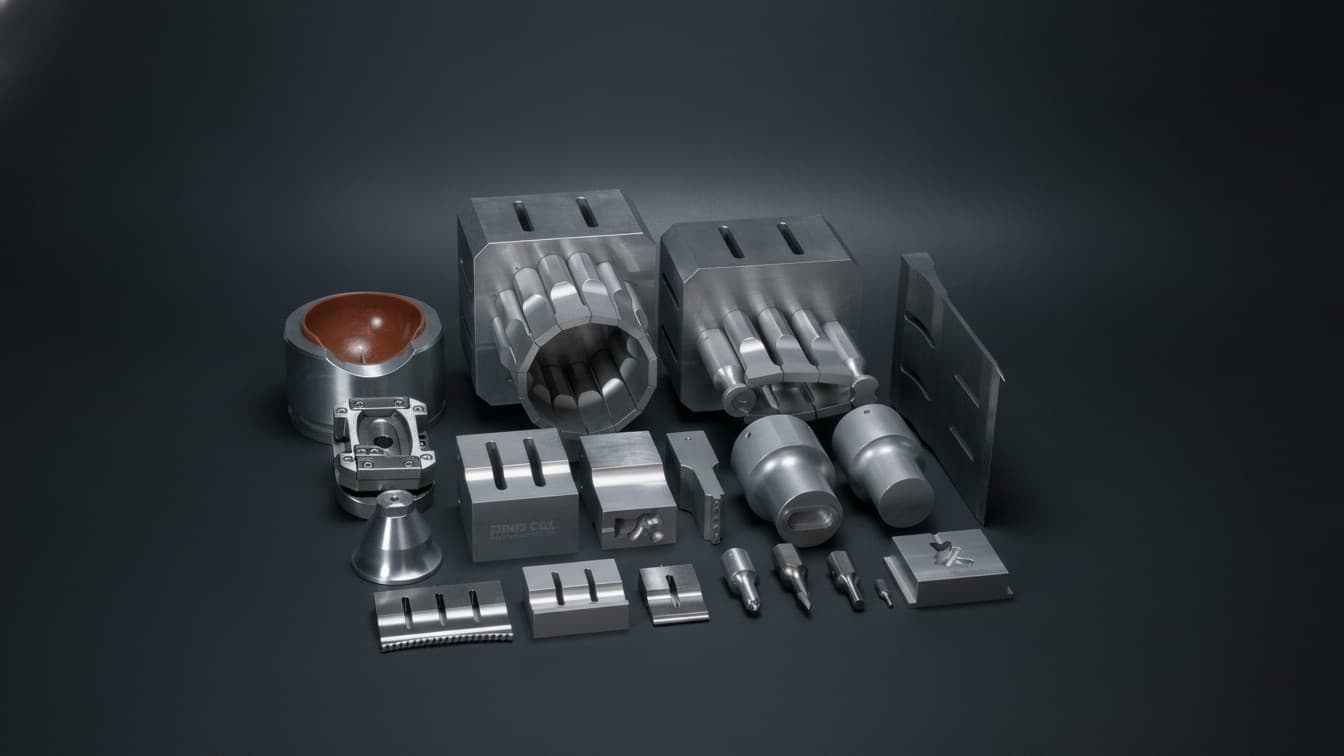
Every ultrasonic welder, cutter and hand unit is built around the same three-part assembly: convertor, booster and horn. Together they are called the ultrasonic stack (or resonant unit), and they are the components that actually do the work — the generator and press exist to drive and position them. Understanding the stack is the key to diagnosing weld problems, specifying new tooling and getting consistent results year after year.
The ultrasonic stack at a glance
Energy flows through the stack in a straight line:
- Generator — converts 50/60 Hz mains power into high-frequency electrical energy at the working frequency, typically 20 kHz or 35 kHz. See our range of ultrasonic generators.
- Convertor (transducer) — converts that electrical energy into mechanical vibration.
- Booster — increases or decreases the vibration amplitude and provides a mounting point.
- Horn (sonotrode) — delivers the vibration into the part, shaped to fit the application.
Every component in the stack is a tuned resonant body. Each one is machined so its natural frequency matches the system frequency — a 20 kHz stack is built entirely of 20 kHz components. Mixing frequencies, or letting a horn drift off frequency through wear or damage, is the root cause of a large share of ultrasonic faults.
The convertor: electrical energy in, vibration out
The convertor contains a stack of piezoelectric ceramic discs clamped between metal masses. When the generator applies its high-frequency voltage, the discs expand and contract, producing a longitudinal vibration of the whole assembly — typically around 10 to 20 microns of movement at the output face, depending on the design and frequency.
Convertors are precision devices and the most sensitive part of the stack. Keep them dry, keep them cool, and never let cooling air carry oil or moisture into the housing. A convertor that has been dropped or overheated may still run, but with reduced output and a shifted resonant frequency that makes the whole system work harder.
The booster: amplitude gain and mounting
The booster sits between convertor and horn and does two jobs.
First, it scales amplitude. A booster is machined with different masses either side of its nodal point; the ratio of those masses sets its gain. A 1:1.5 booster increases amplitude by 50 per cent; a 1:0.6 booster reduces it. Boosters are the standard way to match a stack's output amplitude to the material — semi-crystalline plastics such as polypropylene generally need higher amplitude than amorphous plastics such as ABS or polycarbonate.
Second, it mounts the stack. The booster carries a clamping ring at its nodal point — the position along its length where vibration is essentially zero. Clamping at the node lets the machine hold the stack rigidly without absorbing energy. A worn or incorrectly seated mounting ring shows up as lost power, heating at the clamp, and inconsistent welds.
The horn (sonotrode): where the work happens
The horn is the only custom component in most systems. It transmits vibration into the part, applies the weld force, and its face is shaped to match the part geometry. Because it is a tuned resonant body, a horn is not simply "a shaped block" — its length, profile and any slots or holes are calculated so it resonates at the system frequency with even amplitude across the face. Rinco horns are designed and frequency-tuned for each application; see our ultrasonic tooling page for the range of horn styles and anvils.
Horn materials
- Titanium — the default for production. Excellent acoustic properties, high fatigue strength and good wear resistance. Handles high amplitudes and long duty cycles. The most expensive option, and worth it for any serious production tool.
- Aluminium — low cost and easy to machine, with good acoustic performance but poor wear resistance. Best for prototypes, trials and short runs; often chrome-plated or hard-coated to extend life.
- Hardened steel — used where the horn contacts abrasive materials, such as glass-filled plastics, or for cutting and embossing applications. Steel tolerates lower amplitudes than titanium, so it is a deliberate engineering choice rather than a general-purpose material.
Horn shapes and gain
Horn profile also affects amplitude. Stepped, exponential and catenoidal profiles each trade gain against stress concentration. Larger, block-style horns for big weld areas may be slotted to keep amplitude uniform across the face. The final amplitude at the horn face is the product of the whole chain: convertor output × booster gain × horn gain. Getting that number right for the material is a core part of application engineering.
Frequency and tooling size
| System frequency | Typical horn footprint | Typical use |
|---|---|---|
| 20 kHz | Larger horns, bigger parts | General assembly, larger mouldings, tough semi-crystalline materials |
| 35 kHz | Smaller horns, finer detail | Small and delicate parts, reduced marking, quieter operation |
| 70 kHz | Very small horns | Miniature and sensitive components, hand welding |
Higher frequency means shorter acoustic wavelength, which means physically smaller tuned components and gentler amplitudes — the reason 35 kHz machines such as the Easy 745 suit small, cosmetic or delicate parts, while 20 kHz machines like the Standard 3000 carry the bigger, tougher jobs.
Maintenance and inspection
A healthy stack is quiet (apart from normal process noise), runs cool, and welds repeatably. Build these checks into your routine:
- Inspect horn faces for wear, pitting, cavitation erosion and dents. Surface damage prints onto every part and changes energy coupling.
- Check for cracks — a cracked horn often announces itself with a sudden squeal, a frequency error on the generator, or overload trips. Remove it from service immediately; cracks propagate fast under ultrasonic load.
- Clean and inspect mating faces between convertor, booster and horn whenever the stack is disassembled. These interfaces must be flat, clean and undamaged; fretting corrosion here wastes power and heats the joint.
- Torque stud joints correctly to the manufacturer's specification with the proper spanners. Overtightening damages threads; undertightening causes heating and erratic operation.
- Listen to the generator — modern Rinco generators continuously track the stack's resonant frequency. A steady drift in operating frequency or rising power draw at idle is an early warning of stack trouble.
Custom tooling, supplied locally
Techspan supplies genuine Rinco convertors, boosters and custom-designed horns in New Zealand, backed by Rinco's Swiss tooling engineering. Send us your part drawing or a sample and we can specify the right horn material, gain chain and fixture for the job — and test-weld your parts before the tooling is finalised.
Talk to Techspan
Whether you need a replacement booster, a new horn for a part revision, or a full stack health check, Techspan can help — local stock, local service, and direct access to Rinco's tooling designers. Contact us to discuss your application.